AI in events: faster behind the scenes, invisible in the room
Every event team is being told to use AI. Most are using it in the wrong place. Here is where it earns its keep, where it ruins a night, and how we use it at Börn.
The rule we work by
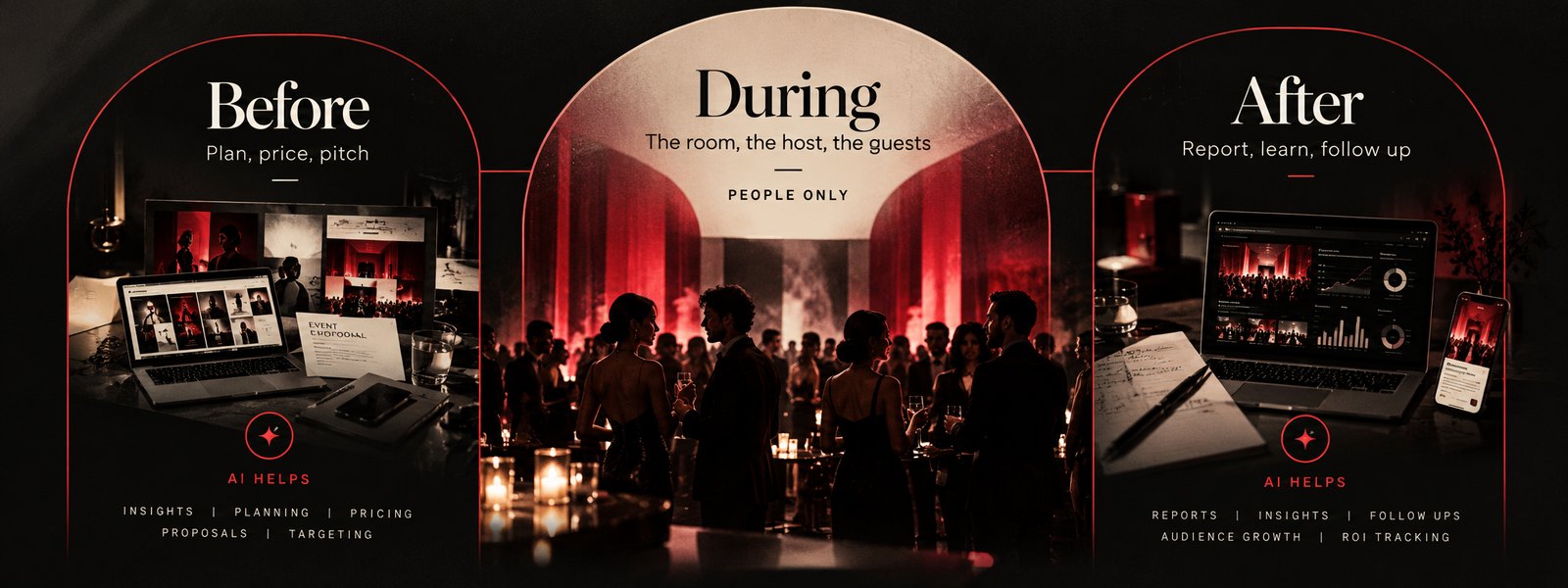
AI belongs in the work before and after the event. It does not belong between the guest and the host. People come to a room to meet people. The moment a guest feels they are being handled by a system, the night loses what made it worth attending.
Where AI helps
- Planning and run-of-show. Timelines, load-in schedules, staffing grids and contingency plans take hours to draft by hand. AI gets you a solid first version in minutes, and your experience fixes the details.
- Budgets and quotations. Costing a stand or a venue means pulling together dozens of line items, local rates and buffers. AI speeds up structuring and checking them. A human still signs off every number.
- Briefs, proposals and sponsor decks. Every brand needs to see itself in the pitch. AI makes it realistic to tailor a proposal to each partner instead of sending one generic deck to everyone.
- Concept development. Testing ten angles for a night before committing to one. It is a fast way to find out what is weak.
- Post-event reporting. Turning attendance, feedback and content into a clear summary a sponsor will actually read.
Where AI hurts
- Chatbots at the door. A bot answering "where is the bar?" is not an experience.
- Generated everything. Visuals, copy and even guest messages that all look the same. Guests notice, and sponsors notice faster.
- Automated guest selection. A curated room is a human judgment. An algorithm will pick the safe crowd, not the interesting one.
- Surveillance dressed up as personalization. Face recognition and tracking turn an invitation into a transaction. In Europe it also brings real legal exposure under GDPR.
If a guest can tell AI was involved, we used it in the wrong place.
How we use it at Börn
We are a small team running events across Sweden, with plans for India and the USA. AI lets us work like a bigger one without pretending to be one.
- Sponsor and partner proposals. For FAKE DATE we build individual proposals for each brand we approach, not one deck for all. AI helps us do that at speed, and we edit every one before it goes out.
- Exhibition and RFP work. For stand projects we use it to structure requirements documents and cost estimates, including local market rates and a contingency buffer, then check against real quotes.
- Concepts and websites. New formats, event pages and early prototypes get drafted with AI so we can test an idea in days.
- Pitch materials. We iterate B2B pitches many times over. AI is a good sparring partner for the wording.
What we do not use it for: choosing who comes, talking to guests, or deciding what a night should feel like. That stays with us.
Where AI belongs in your event
Pick a stage.
| Draft run-of-show and schedules | Use it |
| Structure budgets and quotes | Use it, check every number |
| Tailor sponsor proposals to each brand | Use it, edit each one |
| Choose the guest list | Keep human |
| Chatbot at the door | Skip it |
| Face recognition or tracking | Skip it |
| Live updates to staff | Careful |
| Hosting and reading the room | Keep human |
| Summarise attendance and feedback | Use it |
| Sponsor recap report | Use it, with real numbers |
| Sort feedback into themes | Use it, read the raw comments |
| Personalised thank-you messages | Careful |
Our view, not a rule. Your event and your guests may differ.
Questions to ask before using AI in your event
- Will a guest ever see or feel this? If yes, rethink it.
- Does it save our team time, or only look impressive in a pitch?
- Who checks the output before it goes out?
- What personal data is involved, and do guests know?
Used well, AI gives event teams back their time. The best use of that time is the room itself.
Want a night designed by people who use the tools and still care about the room? Talk to Börn.